Jump to Main Content

Camera Obscura FAQ

Is the camera obscura a new discovery, and who invented it?

The camera obscura has been used for over a thousand years; its origin predates even the invention of optics. The first camera obscura was simply a small hole in one wall of a darkened room or tent. Light passing through the hole formed an inverted (upside down) image of the outside scene on a white screen placed across the room from the hole. The image was dim and fuzzy, but it did accurately show the scenery in full color along with the motion of birds, ocean waves and tree branches swaying in the wind.

Artists were undoubtedly the first “users” of the camera obscura, as they soon realized that one could trace on the screen the outlines of buildings, trees, shadows and animals. This rough sketch could later be filled in with color to achieve the artist’s objectives while maintaining correct perspective and sizes for near and distant objects.

It seems awkward to view an unsharp and inverted image.
Can these problems be solved?

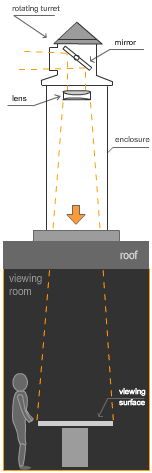
Early diagram of Camera ObscurasBoth difficulties were solved soon after the invention of optics in the early 1600s. When a lens replaced the hole in the wall it produced across the room an image that was both brighter and sharper. However, the scene was still upside down. That problem was solved by arranging the lens to look vertically upward into a flat mirror held at about 45° to the optical axis. Now the image is projected down onto a horizontal white table where the scene will appear right side up if the viewer stands with his back to the outside area of interest.

Early lenses were single pieces of glass that produced a greatly improved image but one that still suffered from color fringes around bright objects an increasing unsharpness° toward the edge of the viewing table. A camera obscura today uses a lens with two or more glass elements that reduce these problems.

Four hundred years ago, the flat mirror was simply a polished metal plate. About 1850, opticians learned how to apply a shiny silver film to a polished flat piece of glass, thereby producing a flatter mirror of much higher reflectivity. Today, most flat mirrors are made by evaporating a film of aluminum onto a polished glass plate. This technique makes a much more durable reflecting surface.

How can I make a simple camera obscura?

Such a basic device is often called a pinhole camera. It is made by cutting a ½ inch hole in one end of a light-tight cardboard box and placing a white paper viewing screen on the opposite side of the box. The imaging pinhole is made in a small piece of aluminum foil that is taped in place over the ½ inch hole.

The pinhole is made in the foil with a needle to produce a clean, sharp hole with a diameter of about 1/100th of the distance from the hole to the screen. For example, if that distance is 10 inches, the pinhole should be about 1/10th of an inch in diameter. Larger pinholes make a brighter but fuzzier image, while because of optical effects, a smaller pinhole also yields a less sharp image.

The image on the white screen may be viewed by mounting the white screen over the hole cut in the side of the box. In this case you view the inverted image through the backside of the white screen. Another arrangement uses a small hole cut in the side of the box that is carefully shielded to keep out stray light yet allow the viewer to see the screen.

How can I make a brighter and sharper image than I get with a pinhole camera?

A better image is made by replacing the pinhole with a lens whose focal length is equal to the distance from the lens to the viewing screen. The diameter of the lens might be ½ to 1 inch for a focal length of 10 inches. In a basic instrument this can be a simple lens made of one lens element. Such lenses are available from the Edmund Optics Company (www.edmundoptics.com).

Remember, both the pinhole and the lens produce an inverted image.

The pinhole camera is nice, but how can I make an image
that shows more detail and appears right side up?

To achieve these improvements you must make a much bigger camera obscura in which the viewer sits inside the instrument. Such a device uses a larger lens of longer focal length and also includes a flat mirror mounted above the lens. The viewers now sit or stand inside the darkened room to see the image on a horizontal white table. Those viewers with their back to the scene of interest will see a right side up image.

The smallest such instrument suitable for a single viewer might use a lens of 40 or 50-inch focal length. This device would display details in the scene 4 or 5 times larger than produced by the 10-inch instrument described above. Larger lenses with even longer focal length can reveal surprising features of very distant objects. For instance, a lens of 100 inches focal length will show an image of the full moon that is about 1 inch in diameter. Such a view is like looking at the scene with a 10 power binocular. The largest camera obscuras today use lenses of 12 to 14 inches diameter and produce focal lengths of 250 to 350 inches.

Large instruments are usually equipped with electric motors to carefully rotate the flat mirror about the vertical axis (azimuth) and to tilt the mirror to shift the view upwards or downwards (altitude). Many camera obscuras also provide means to move the lens vertically over several inches to focus the instrument on near or distant objects.

As the focal length of the lens is increased, the lens diameter must also be made larger in order to maintain adequate image brightness. The ratio of lens focal length to diameter is called the speed or f/number of the lens; this ratio determines the brightness of the scene on the table. This brightness is proportional to the square of the f/number. For example, the image produced by an f/8 lens is four times brighter than that made by an f/16 lens. Most camera obscuras use lenses of f/15 to f/30. Note that the apparent image brightness is strongly affected by stray light; the viewing room must be as near to total darkness as possible.

Can I expect to view astronomical objects through
the camera obscura?

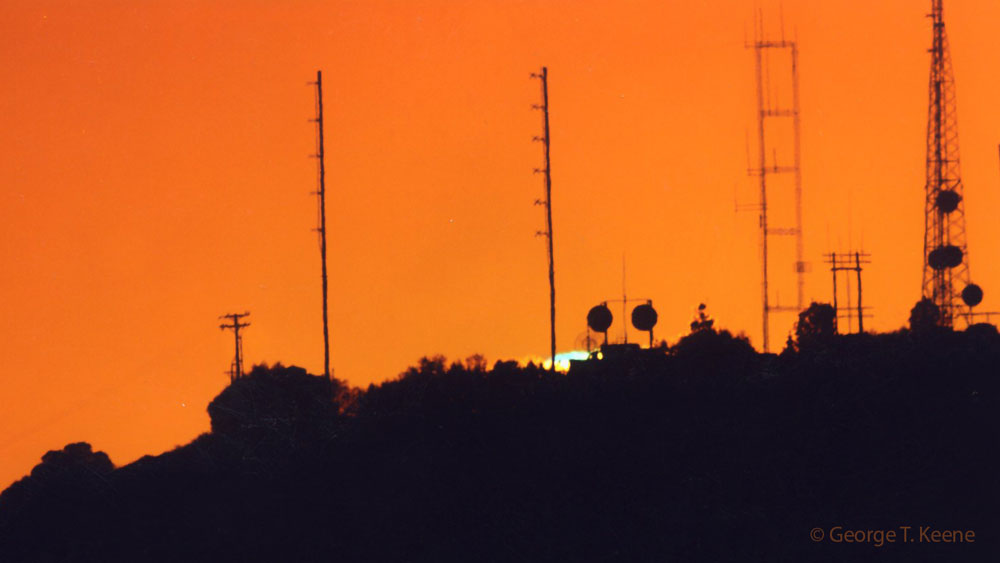
Most camera obscuras are arranged to view the surrounding landscape of buildings, mountains, a coastline or a harbor scene. These views occasionally will include a dramatic sunset or moonrise and indeed, such a scene can be especially dramatic. Observers must use great care in looking toward the sun, as even a reddened sun near the horizon can easily cause serious eye damage or blindness if viewed directly. The solar image on the view table may be dazzling but it will not cause permanent eye damage.

The instrument can be specially designed to see the moon and bright planets even when 30° or 40° above the horizon. Such a camera obscura must include a flat mirror that is significantly larger than normal. A conventional camera obscura uses a flat mirror that is an inch or two wider than the lens diameter and also about 1.5 times longer than its width. The difference between length and width is cause by the need to place the mirror at 45° to the lens optical axis. For example, a lens of 6-inch diameter would require a flat mirror of about 7x10 inches.

If the camera obscura is to view objects higher in the sky it must use a flat mirror of the standard width but with up to twice the usual length. Such a flat will be much more expensive than a normal mirror.